
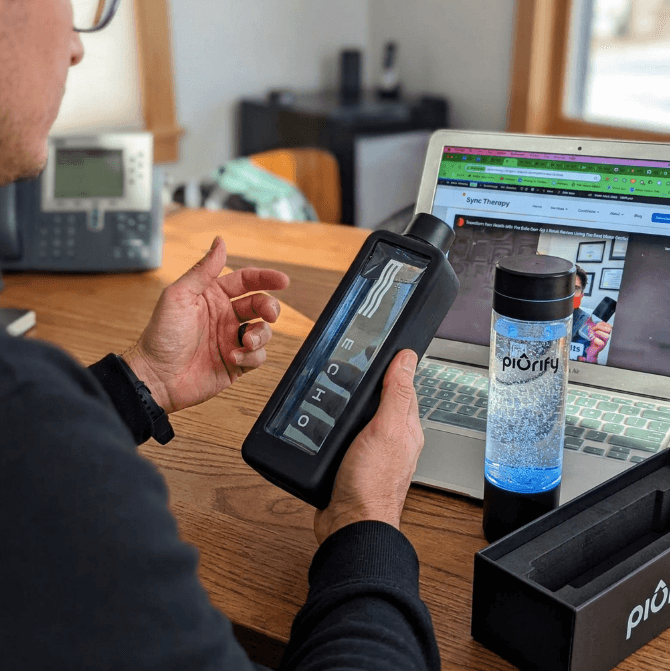
Battery life is one of the most common questions about the Echo Flask. If you're spending $299 on a hydrogen water bottle, you want to know it won't die halfway through the day. Here's the full breakdown—cycles per charge, charge time, degradation, and how it holds up for travel.
Cycles Per Charge
The Echo Flask runs hydrogen generation cycles in either 10-minute mode (up to 6 ppm) or 20-minute mode (up to 8 ppm). On a full charge, you can expect multiple cycles before needing to plug in.
| Usage Pattern | Estimated Charge Duration |
|---|---|
| Light use (1-2 cycles/day) | 3-4 days between charges |
| Moderate use (3 cycles/day) | 2-3 days between charges |
| Heavy use (4+ cycles/day) | 1-2 days between charges |
The 20-minute cycle uses more battery than the 10-minute cycle. If you primarily use the longer cycle for maximum hydrogen concentration, expect to charge more frequently.
Charge Time
The Echo Flask charges via USB-C and typically reaches a full charge in approximately 2-3 hours. The built-in touchscreen displays the current battery level so you always know where you stand.
Tip: Charge the Flask overnight or while you're at your desk. A nightly charge means you'll never run out of battery during the day, even with heavy use.
Battery Degradation Over Time
Like any rechargeable lithium battery, the Echo Flask battery will gradually lose capacity over time. This is normal and expected. After several hundred charge cycles, you may notice slightly shorter battery life per charge.
The Echo Flask's 5-year warranty covers the battery under normal use conditions. Echo Water also offers Echo Care for extended battery coverage, which is worth considering if battery longevity is a concern.
Best practices to extend battery life:
- - Avoid letting the battery fully drain regularly
- - Don't leave it plugged in for extended periods after reaching full charge
- - Store in a cool environment when not in use
- - Use the included USB-C cable or a quality replacement
Travel Use
The Echo Flask is practical for travel. At 12 oz it's a reasonable portable size, and a full charge lasts multiple days at moderate use. You can charge it from any USB-C source—laptop, power bank, or wall adapter.
- Weekend trips: A single charge should cover a 2-3 day trip at moderate use
- Longer trips: Bring a USB-C cable and charge as needed
- Air travel: The Echo Flask's lithium battery is within airline carry-on limits
- Water quality: Use filtered or bottled water when traveling—tap water quality varies and can affect hydrogen generation and electrode longevity
Battery: Echo Flask vs Echo Go+
If battery flexibility is your top priority, it's worth noting that the Echo Go+ can be used while charging. The Echo Flask cannot. However, the Echo Flask offers significantly higher hydrogen output (up to 8 ppm vs 4.5 ppm) and the smart touchscreen with battery monitoring.
More Echo Flask Guides
- → Echo Flask Review — Full specs, pros, cons, and verdict
- → Echo Flask 8 PPM — What the hydrogen concentration means
- → Echo Flask vs Echo Go+ — Complete comparison
Buy Echo Flask
Use code: SYNCTHERAPY for 15% off
Get Echo Flask (15% Off)Free shipping on orders over $99 | 5-year warranty included