Anterior Knee Pain (Runner's Knee)
Relief in Colwood
Biomechanical, corrective, and active care crafted for Langford and West Shore runners. We identify how your kneecap is tracking and correct the tension networks causing friction.
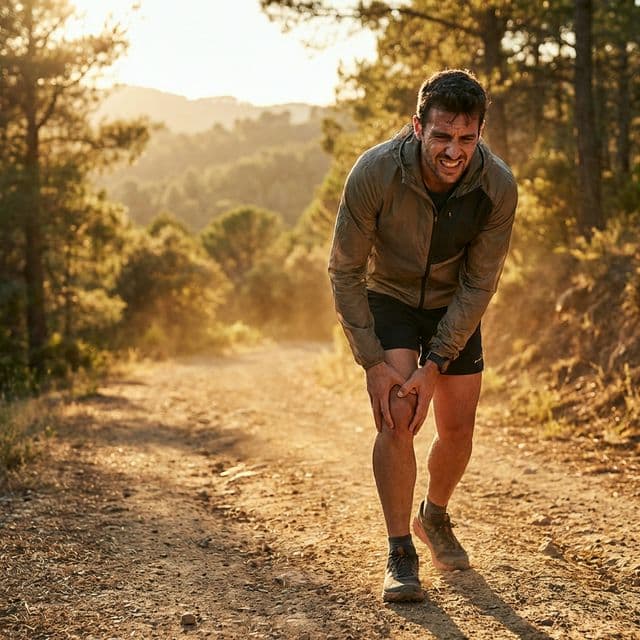
Is This You?
The "Movie Theater Sign"
Sitting for a long period with your knees bent (like in a movie theater or at a desk) causes a deep aching pain immediately behind the kneecap.
The "Downhill Grind"
Your pain is significantly worse when running downhill or stepping repeatedly down a heavy flight of structural stairs.
The "Popping Sensation"
You frequently feel or hear an audible popping, grinding, or loud clicking beneath the kneecap when you straighten the leg.
The "Mileage Limit"
You can often start a run fine, but at a very specific, consistent repetitive distance, the knee pain sharply forces you to stop.
Patellofemoral Tracking & Friction
Anterior knee pain, or patellofemoral pain syndrome, is a mechanical tracking problem. The kneecap (patella) is designed to slide smoothly up and down a specific groove in the thigh bone. If your outer thigh muscles (TFL/IT band) pull harder than your inner thigh muscles, the kneecap is physically dragged off-center. Every time you bend the knee, it aggressively grinds against the bone instead of sliding smoothly.
Our Diagnostic Approach
We measure the precise angles and forces acting directly upon your patellofemoral joint.
Patellar Grind Test (Clarke's Sign)
Assessing the smoothness of the cartilage and identifying the specific frictional resistance points.
Q-Angle Measurement
Calculating the precise mechanical angle between your hips and knees to determine how off-center the patella is being pulled.
The Sync Difference
Our dual-credentialed approach is vital here. As an RMT, we can manually manipulate and strip the incredibly dense fascial tension of the outer hip and IT band that is pulling the kneecap laterally. Simultaneously, as an Athletic Therapist, we prescribe perfectly calibrated muscular activations for the medial (inner) quadriceps to firmly pull the knee cap back to center, correcting the tracking issue permanently.
High-Value Tip You Can Try Today
Stop Rolling Your IT Band: Foam rolling your IT band directly repeatedly is often incredibly painful and doesn't work well because it's thick, non-contractile fascial tissue; it doesn't "relax." Instead, roll the TFL (the small hip flexor muscle at the very top of your hip pocket). Releasing the TFL relieves the massive tension pulling on your kneecap from above.
Explore Related Conditions
Your Practitioner
Clinical care provided by Daryl Stubbs, RMT & CAT(C). Specializing in lower limb running mechanics and fascial tracking dysfunctions.
Read Full Bio →Award-Winning Care in Colwood
Kind Words from Our Patients
Recent 5-Star Reviews from your neighbors in Colwood & Langford.
Frequently Asked Questions
Do I have to stop running entirely?
Not always. We focus on load management. Often, modifying a runner's weekly volume or adjusting biomechanical stride rather than completely halting activity produces the most effective adaptation.
Is my knee cartilage permanently damaged?
Anterior knee pain is frequently caused by friction and active tissue inflammation, not permanent arthritis. Retraining how the kneecap moves usually resolves the localized pain entirely.
Will a knee brace fix this?
A brace can provide temporary proprioceptive relief, but it acts solely as a band-aid. True rehabilitation requires strengthening the hip and thigh muscles to naturally pull the kneecap back into proper alignment.