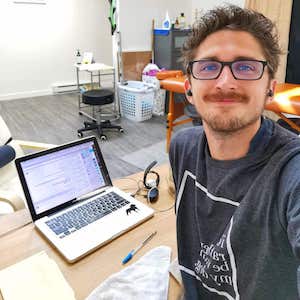
Clinical Perspective: As a certified athletic therapist, I evaluate red light masks on irradiance, wavelength accuracy, and build quality — the same criteria I use for clinical panels. Face masks need to deliver enough photons at the right depth to produce measurable collagen stimulation and tissue repair, not just glow aesthetically.
The Bon Charge face mask review verdict: this is the highest-LED consumer face mask on the market at 240 LEDs and 40.8 mW/cm², and it undercuts Omnilux and CurrentBody on price. I don't own the Bon Charge mask — my daily driver is the Kala, which adds 465nm blue light for acne — but the Bon Charge specs are the strongest I've seen in this price bracket. If acne isn't your primary concern, it's the most compelling mask available under $400.
Quick verdict
- ✓ 240 LEDs — nearly double Omnilux and CurrentBody (132 each)
- ✓ 40.8 mW/cm² — strong irradiance for a cordless mask
- ✓ 630nm + 850nm — proven wavelengths for skin and tissue depth
- ✓ Cordless, USB charging — no cable tethering during sessions
- ✓ A-grade silicone — flexible fit, contoured eye cups, no goggles
- ✗ No blue light — not the right tool for active acne
- ✗ Proprietary charging cable — minor inconvenience
- ✗ No FDA Class II clearance — FDA registered, not classified as medical device
Use code SYNCTHERAPY for 10% off
Bon Charge red light face mask specs
| Spec | Bon Charge |
|---|---|
| Wavelengths | 630nm (red) + 850nm (NIR) |
| LED count | 240–242 |
| Irradiance | 40.8 mW/cm² (combined) |
| Material | A-grade flexible silicone |
| Eye protection | Contoured eye cups (no goggles needed) |
| Power | Cordless, USB charging, ~3 hrs/charge |
| Intensity settings | 3 levels (via 'E' button) |
| Session time | 10–30 min, 3–7×/week |
| EMF output | 0 mG |
| Certifications | FDA registered, CE, FCC, SAA |
| Warranty | 1 year |
| Price (USD) | ~$349 |
What 240 LEDs actually means
Omnilux Contour and CurrentBody Skin — the two most clinically cited consumer masks — both use 132 LEDs. The Bon Charge LED mask delivers 240–242, which means more uniform coverage across the forehead, cheeks, jaw, and chin. Fewer dark spots between diodes. Higher surface-area photon delivery.
The 40.8 mW/cm² combined irradiance puts Bon Charge in the clinical sweet spot. Too low (under 20 mW/cm²) and you're extending sessions to impractical lengths. Too high (above 100 mW/cm² at skin contact) and you risk diminishing returns through biphasic dose response. At 40.8 mW/cm², a 10–20 minute session delivers a clinically meaningful dose without overexposure risk.
"I evaluate face masks the same way I evaluate clinical panels: irradiance at skin surface, wavelength accuracy, and build consistency. The Bon Charge numbers are strong — 240 LEDs at 40.8 mW/cm² is better than most masks I've reviewed. My daily mask is the Kala because I need the 465nm blue for acne clients. But if acne isn't the goal, Bon Charge has a legitimate argument for being the best-spec mask under $400."
Bon Charge LED mask vs the competition
| Mask | LEDs | Wavelengths | Irradiance | Price (USD) |
|---|---|---|---|---|
| Bon Charge | 240–242 | 630nm + 850nm | 40.8 mW/cm² | ~$349 |
| Omnilux Contour | 132 | 633nm + 830nm | Not published | ~$395 |
| CurrentBody Skin | 132 | 633nm + 830nm | Not published | ~$380 |
| Kala Face Mask | 66 triple-chip | 630nm + 830nm + 465nm blue | 20/10/10 mW/cm² | ~$349 |
| HigherDOSE | 132 | Red + NIR | Not published | ~$299 |
Omnilux publishes peer-reviewed clinical trial data and is the dermatologist-favorite brand — that carries real weight. CurrentBody is similar hardware to Omnilux, priced $15 less. HigherDose leads on price but doesn't publish irradiance data. The Kala's triple-chip LEDs with 465nm blue give it a clinical edge for acne specifically — I use mine on acne-prone clients. For everything else (collagen, fine lines, inflammation, wound healing), Bon Charge's raw LED count and published irradiance make it the strongest spec sheet under $400.
See the full breakdown: Bon Charge vs Omnilux, Bon Charge vs CurrentBody, and Bon Charge vs HigherDose face mask.
The science behind 630nm and 850nm
Red light at 630nm penetrates ~2–3mm into tissue, primarily targeting epidermal and dermal cells — fibroblast stimulation, collagen synthesis, and superficial inflammation. Near-infrared at 850nm reaches 5–10mm depth, affecting deeper dermal layers and underlying musculature. A 2014 randomized controlled trial by Wunsch & Matuschka (n=113, PMID 24286286) found significant improvements in skin complexion, collagen density, and elasticity with red/NIR light. These are the same wavelengths Bon Charge uses.
Who should buy the Bon Charge mask
Buy it if...
- ✓ Your goals are anti-aging, fine lines, or skin tone
- ✓ You want the highest LED count in this price range
- ✓ You want cordless freedom during sessions
- ✓ You want transparent, published irradiance specs
- ✓ Budget is ~$349 and you're comparing Omnilux or CurrentBody
Skip it if...
- ✗ Active acne is your primary concern (needs blue light)
- ✗ You want FDA Class II medical device status
- ✗ You rely on dermatologist-cited clinical trial data (Omnilux wins here)
- ✗ You're a Canadian buyer sensitive to duties (check import costs)
Pros and cons
Pros
- ✓ 240 LEDs — highest in class under $400
- ✓ 40.8 mW/cm² published and verifiable
- ✓ Fully cordless with ~3 hours battery life
- ✓ Flexible A-grade silicone — conforms to face shape
- ✓ Contoured eye cups — no safety goggles needed
- ✓ 3 intensity levels for dose control
- ✓ 0 mG EMF — no electromagnetic field exposure
- ✓ HSA/FSA eligible
- ✓ 30-day return policy
Cons
- ✗ No blue light — not effective for acne bacteria
- ✗ Proprietary charging cable
- ✗ FDA registered, not FDA Class II cleared
- ✗ Only 1-year warranty (Kala offers 2 years on their mask)
- ✗ Ships from Australia — Canadians should verify duty/import costs
Use code SYNCTHERAPY for 10% off
How to get the best results
Start with clean, dry skin — no serums or SPF before sessions. LED light doesn't penetrate through physical barriers, so product residue reduces efficacy. Use 10–20 minutes daily for the first 8 weeks at medium intensity, then drop to 3–4× per week for maintenance. Apply a hyaluronic acid serum or vitamin C immediately after — the mild thermal effect opens microvasculature, improving product absorption for 15–20 minutes post-session.
The 3 intensity levels matter: start at level 1 if you have sensitive skin, escalate to level 3 once your skin has adapted. I'd recommend staying at level 2 for the first two weeks regardless of skin type to establish a baseline response before increasing dose.
Frequently asked questions
How many LEDs does the Bon Charge mask have?
The Bon Charge Red Light Face Mask has 240–242 LEDs delivering 40.8 mW/cm² combined irradiance at 630nm and 850nm. That's nearly double the 132 LEDs in Omnilux Contour and CurrentBody Skin masks.
Bon Charge mask vs Omnilux?
Bon Charge has 240 LEDs vs Omnilux's 132, and 40.8 mW/cm² published irradiance vs Omnilux's unpublished specs — giving Bon Charge an edge in coverage and power density. Omnilux is dermatologist-recommended with a stronger clinical track record. Bon Charge costs about $45 less (~$349 vs ~$395). See the full breakdown at Bon Charge vs Omnilux.
Does Bon Charge mask have blue light?
No. The Bon Charge mask uses only 630nm red and 850nm near-infrared light. There is no blue light (465nm). If you're treating active acne, the Kala mask adds 465nm blue light, which has clinical support for acne reduction. See my Kala face mask review for a direct comparison.
How often should you use the Bon Charge mask?
Bon Charge recommends 3–7 sessions per week, 10–30 minutes per session. For skin rejuvenation, most clinical protocols suggest daily 10–20 minute sessions for the first 8–12 weeks, then 3–4× per week for maintenance.
Final verdict
The Bon Charge red light therapy face mask is the best-spec mask under $400 for anti-aging and skin rejuvenation goals. At 240 LEDs and 40.8 mW/cm², it outguns Omnilux, CurrentBody, and HigherDose on raw hardware. The two weaknesses are real: no blue light means it can't address acne bacteria, and the 1-year warranty is shorter than the Kala's 2-year coverage. But if your goals are collagen stimulation, fine lines, redness, or inflammation — and you want the highest LED density in this price range — the Bon Charge mask is the one to buy.
I haven't used the Bon Charge mask personally — my current mask is the Kala, which I chose for the blue wavelength addition. But I regularly recommend Bon Charge to clients whose goals don't require blue light, and the feedback has been consistently positive. See where the mask fits in the full Bon Charge product lineup overview for context on their panels and PEMF devices too.
For a broader look at the mask category, see my best red light therapy masks guide.
Use code SYNCTHERAPY for 10% off
Related reviews & guides
Save 10% on Bon Charge — Code: SYNCTHERAPY