Rotator Cuff Injury Treatment
in Colwood
Precise, rehabilitative, and mobility-focused care. We isolate the specific torn or inflamed tendon within the shoulder complex to deliver truly targeted recovery strategies.
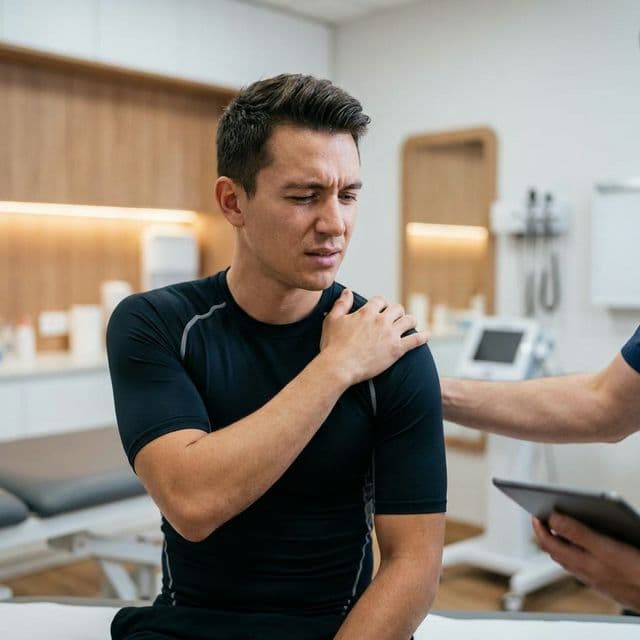
Is This You?
The "Overhead Catch"
Reaching up to grab something from a high shelf or putting on a jacket causes a sudden, stabbing pain deep inside the shoulder.
The "Weak Arm"
You physically struggle to hold your arm out to the side; it feels incredibly heavy or drops involuntarily due to sudden weakness.
The "Sleepless Night"
Your shoulder aches constantly at night, completely disrupting your sleep, especially if you happen to roll onto the affected side.
The "Rear Reach Pinch"
Reaching behind your back (like grabbing a wallet or fastening clothing) sends a sharp, intense pinch into the front of the joint.
Structural Anatomy & Tendon Attrition
The rotator cuff isn't just one muscle; it's a structural group of four deeply situated muscles that act as dynamic stabilizers, literally pulling your arm bone securely into the shoulder socket as you move. Injuries happen when these precise, small tendons are asked to handle explosive loads they aren't prepared for, or when poor posture chronically pinches them against bone, slowly wearing the tendon fibers down over time.
Our Diagnostic Approach
We use specific clinical movements to isolate and identify WHICH of the four tendons is actually compromised.
Drop-Arm Test
Checking for full-thickness tears in the supraspinatus tendon.
Empty Can Test
Isolating specific inflammatory responses at specific angles of elevation.
Scapular Dyskinesis Evaluation
Assessing how effectively your shoulder blade moves dynamically across your ribcage.
The Sync Difference
Because we integrate Athletic Therapy with Registered Massage Therapy, we excel at complex joints like the shoulder. We aggressively release the heavy, overriding muscles (like the pecs and lats) that are neurologically restricting the joint, and immediately follow up with focused, active rehabilitation strictly targeting the deep rotator cuff stabilizers, restoring true mechanical function.
High-Value Tip You Can Try Today
Modify Your Sleep Position: Avoid sleeping with your injured arm extended overhead under your pillow. This specific position severely compresses the joint space, drastically reducing blood flow simultaneously to the same rotator cuff tendons that so desperately require oxygen to heal overnight. Keep the arm neutral and slightly supported.
Explore Related Treatments
Your Practitioner
Clinical care provided by Daryl Stubbs, RMT & CAT(C). Specializing in complex shoulder joint mechanics and deep tissue stabilization.
Read Full Bio →Award-Winning Care in Colwood
Kind Words from Our Patients
Recent 5-Star Reviews from your neighbors in Colwood & Langford.
Frequently Asked Questions
Can a rotator cuff tear heal without surgery?
Many partial tears or severe tendinopathies can be successfully managed and rehabilitated without surgical intervention by strengthening the surrounding compensatory musculature to stabilize the joint.
Should I wear a sling?
Generally, prolonged immobilization in a sling after the initial acute phase (first 48-72 hours) is discouraged as it can lead to severe muscle atrophy and "frozen shoulder" complications.
Why does my shoulder hurt worst at night?
When you lie down, the structural layout of your shoulder shifts, often compressing already inflamed tendons against the surrounding bones, reducing blood flow and increasing swelling in a confined space.